
Cheerleading Was Never a Joke—Until Women Started Doing It
Cheerleading was once a respected leadership role held by presidents and Ivy League men.
So why did it lose status when women took over? This post unpacks the gendered evolution of cheer and what it reveals about sexism in sport.
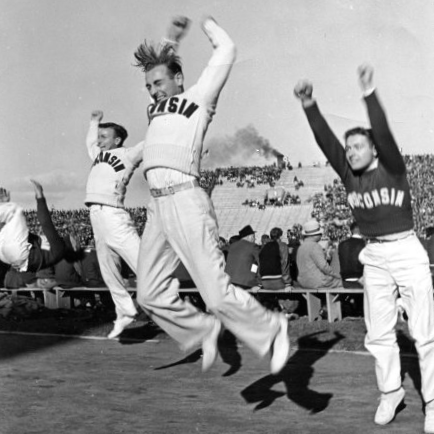
Male cheerleaders in action at Wisconsin-Marquette football game, 1939. (Alfred Eisenstaedt—The LIFE Picture Collection)
Long before cheerleading was reduced to short skirts and fake smiles, it was a launchpad for future presidents, Hollywood legends, and Supreme Court justices. Franklin D. Roosevelt was Harvard’s head cheerleader. Dwight D. Eisenhower picked up the megaphone at West Point. Back then, cheerleading was considered serious business: leadership, discipline, character.
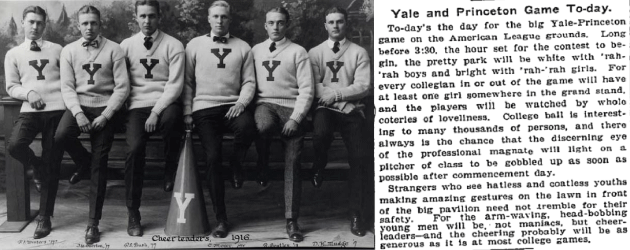
Left: the Yale cheerleading team in 1916. Right: a New York Times article in 1909. (Yale University Library, New York Times)
But then WWII happened. The men went to war, and women filled the sidelines. Practically overnight, cheerleading stopped being a leadership pipeline and became a sideshow. The media began framing it as decorative, unserious, and overly feminine.
The chart below? It’s your proof that what changed wasn’t the sport—it was who got to do it. Scroll down and watch the respect vanish in real time.

In the early 1900s, football took off, and with it came the rise of all‑male “yell teams.” A 1911 article in The Nation even claimed, “The reputation of having been a valiant ‘cheer-leader’ is one of the most valuable things a boy can take away from college. As a title to promotion in professional or public life, it ranks hardly second to that of being a quarterback.”
In fact, Stanford University offered cheerleading courses in the 1920s with titles like “Bleacher Psychology” and “Development of Stage Presence”—all designed to boost leadership and public speaking skills. At this point, cheerleading was viewed as preparation for public life, not pom-pom fluff.
“The reputation of having been a valiant ‘cheer-leader’ is one of the most valuable things a boy can take away from college. As a title to promotion in professional or public life, it ranks hardly second to that of being a quarterback.”
-The Nation, 1911
By 1940, there were over 30,000 cheerleaders in the U.S., most of them men. Women were often barred from cheering, especially in elite academic settings. Where they were allowed, they were rarely welcomed. The traits associated with cheerleading—being loud, visible, and authoritative—ran counter to the ideals of womanhood at the time.
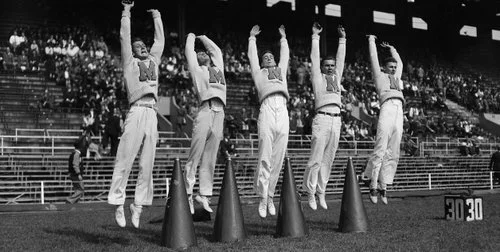
University of Maryland cheerleaders rally a crowd in October, 1937. (Bettmann / Getty Images)
That began to change during WWII. As men left to serve, women took over cheerleading teams. By the 1950s, the field had become overwhelmingly female, and its prestige had disappeared. Instead of leadership, the narrative shifted to cuteness, coordination, and later, sex appeal. In 1948, Lawrence Herkimer hosted the first cheerleading camp. Out of 53 attendees, 52 were girls. He started selling crepe-paper pom-poms from his garage, eventually patenting them in 1971.
“The traits associated with cheerleading—being loud, visible, and authoritative—ran counter to the ideals of womanhood at the time.”
This shift wasn’t just about visibility; it was about value. Cheerleading had changed in the eyes of the public, not because it became less demanding, but because it became more feminine.
The 1970s brought sharper contrasts. On one side, you had the rise of competitive cheer — a physically demanding, acrobatic, and intense sport complete with pyramids, tumbling, and intense training. On the other hand, professional cheerleading for NFL teams grew increasingly sexualized. The Dallas Cowboys Cheerleaders became cultural icons not for their athleticism, but for their outfits and allure. In 1977, The New York Times declared them “The best thing about the Dallas Cowboys.”
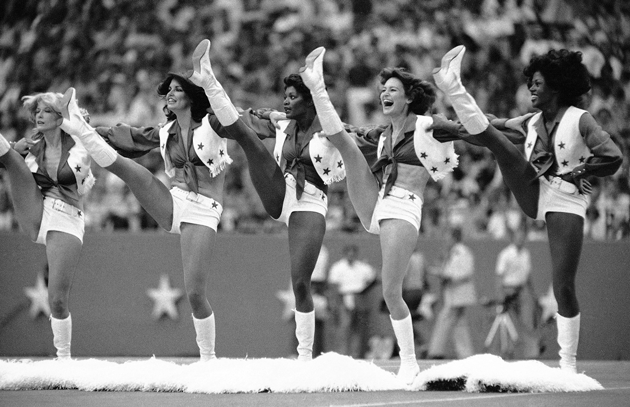
Dallas Cowboys Cheerleaders, 1978. (Associated Press)
“Cheerleading had changed in the eyes of the public, not because it became less demanding, but because it became more feminine.”
They were expected to rehearse for hours, maintain strict diets, and abide by rigid codes of conduct—all for just $14.72 per game. They couldn’t wear jewelry, attend parties, or be seen where alcohol was served. They were required to project “all-American charm and class,” while still being sexy enough to entertain a male-dominated audience.
As choreographer Texie Waterman put it, their routines were meant to be a “tantalizing dance… designed to flirt with sex appeal while retaining an aura of all-American charm and class with Christian values.”
This impossible standard is a textbook example of policed femininity: be desirable, but not too desirable; sexy, but wholesome; visible, but not powerful. It reflects what feminist theorists call the Madonna/whore dichotomy—the tightrope women are constantly expected to walk.
Meanwhile, competitive cheerleaders were flipping and flying and still being told their sport “Wasn’t real.”
“This impossible standard is a textbook example of policed femininity: be desirable, but not too desirable; sexy, but wholesome; visible, but not powerful.”
Cheerleading didn’t lose value because the activity changed. It lost value because women inherited it.
So what would it look like if we took cheerleaders seriously again?
Stay tuned.